Are Dogs Allowed in Texas State Parks: The Full Guide
Yes, dogs are allowed in almost all Texas state parks, but only on a 6-foot leash or shorter, in a vehicle, or in a crate, and never in buildings, swimming areas, or other restricted zones. If you’re loading the cooler, clipping on the leash, and heading out with your dog, that’s the answer you need to start with, but the key is knowing what allowed means at a TPWD park.
Table of Contents
- A Quick Answer for Dog Owners Heading to Texas State Parks
- The Statewide Rules Every Texas State Park Dog Owner Must Follow
- When Legal Access Is Not the Same as Safe Access
- How to Check Park-Specific Rules Before You Go
- A Quick Look at Dog-Friendly Texas State Parks by Region
- Common Misconceptions Dog Owners Bring to Texas State Parks
- Putting It All Together for Your Next Trip
A Quick Answer for Dog Owners Heading to Texas State Parks
If you’re halfway packed and wondering whether your dog can come along, the short answer is yes, in most Texas state parks, but only under tight control. TPWD treats dog access as conditional access, not open-ended permission, so the rule is less “dogs welcome everywhere” and more “dogs welcome where the site rules and your supervision allow it” (TX State Parks dog-friendly guide).
That distinction matters because a lot of confusion starts right there. A dog may be allowed into the park, but still barred from a cabin, a restroom, a lodge, a shelter, a park store, a swim beach, or a designated swimming area. In other words, the gate being open doesn’t mean every trail, building, and shoreline is open too.
Practical rule: treat every park visit as two questions, first, “Is my dog allowed here?” and then, “Is this a good place for my dog today?”
A good first check is the park’s own rules page, because some areas inside a park can be off-limits even when dogs are otherwise permitted. That includes park-specific restrictions, wildlife-sensitive areas, and swim zones, so don’t rely on a general memory of “Texas parks allow dogs” and stop there.
The easiest way to stay out of trouble is to think in layers. Start with the statewide rule, then check the specific park, then decide whether your dog can handle the heat, terrain, and wildlife pressure that day. That’s the part most visitors miss, and it’s the difference between a legal trip and a miserable one.
The Statewide Rules Every Texas State Park Dog Owner Must Follow
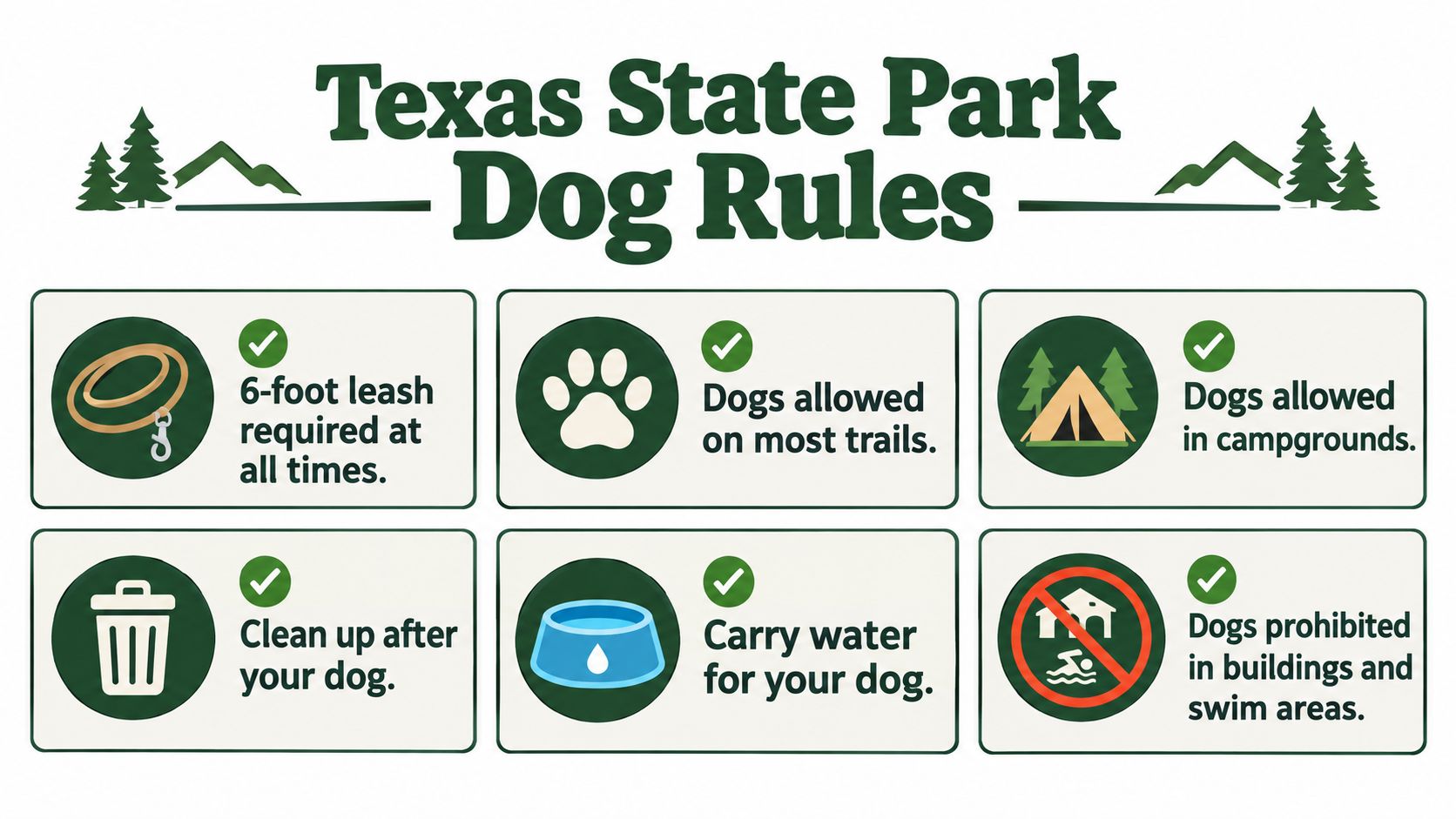
TPWD’s default standard is simple but strict. Unless your dog is inside a vehicle or a suitable crate, it must stay on a leash no longer than 6 feet, and you have to stay with it at all times. That is the baseline across most Texas state parks, and it is easy to miss if you assume a quiet trail means an off-leash day (TPWD FAQ).
The control rules that matter most
A dog cannot be left unattended in a park, vehicle, or campsite. The responsible visitor has to remain with the dog, keep it under control, and immediately collect and dispose of its waste in an appropriate container. TPWD also prohibits dogs that are noisy, dangerous, vicious, or otherwise disruptive (TPWD regulations).
That waste rule is more than etiquette. It protects sanitation and helps limit water-quality problems, especially in busy day-use areas and campgrounds. The leash rule works the same way on the trail, keeping dogs close to you, reducing wildlife encounters, and lowering the chance of conflict with other visitors.
Where dogs are not allowed
Dogs are not allowed in state-park buildings such as cabins, restrooms, lodges, shelters, and park stores. TPWD also bars pets from designated swimming water and the adjacent beach or land area, and the statewide framework makes it an offense to bring a pet into any area where pets are prohibited.
If a park has a swim beach, assume the water edge may be part of the restricted zone until you confirm otherwise on the park page.
TPWD advises visitors to carry proof of a current rabies vaccination. Service animals accompanying people with disabilities receive exceptions under applicable rules, but emotional-support animals do not automatically qualify as service animals (TPWD FAQ).
When Legal Access Is Not the Same as Safe Access
Big Bend Ranch is a good reminder that a dog can be allowed and still not be a good idea for the day. TPWD warns that summer temperatures there average above 100°F, and it also points to dry air, rough rocky terrain, and the risk of disease or parasite transmission between dogs and wildlife as reasons for caution (Big Bend Ranch dog policies).
Heat, ground, and water change the answer
A trail can be legal for dogs and still be a poor choice in the heat. TPWD’s statewide heat guidance says to press the back of your hand to pavement or ground for five seconds. If it is too hot for your hand, it is too hot for your dog’s paws. The same guidance recommends water, booties, and foot care when surfaces get hot.
Practical judgment matters here. A shaded morning walk near a creek is a different outing from a midday hike in open country. Rocky ground can wear down pads fast, and a park with limited water can be manageable for a fit dog in cool weather but hard on an older dog in dry heat.
Wildlife and rescue difficulty matter too
TPWD also says pets must not approach wildlife, and its rules prohibit feeding or harassing wildlife. In remote or rugged parks, that warning matters because a dog’s instincts can put it in trouble fast.
Dogs with short muzzles, older dogs, and dogs that are not well conditioned need extra caution because heat and exertion stack up quickly. In parks with long distances, little shade, or rough footing, the question is not only whether your dog is allowed. It is whether the park can support a safe outing without turning the day into a hard recovery for both of you.
How to Check Park-Specific Rules Before You Go
Start with the park’s official TPWD page, because that’s where local exceptions usually show up. Look for pet rules, swim-beach notes, day-use alerts, campground details, and any facility-specific restrictions, then check again close to your visit date because closures and rules can change.
A simple pre-trip routine
-
Open the park page early.
Read the pet section first, then scan the alert banner and any notes about beaches, trails, cabins, or day-use zones. -
Confirm the restricted spots.
A park may allow dogs in general but still bar them from swimming areas, buildings, or certain shoreline sections. -
Recheck the week you travel.
Weather, wildlife management, and maintenance can change access details after you’ve already planned the trip. -
Call if anything is unclear.
If the page language feels incomplete or you’re heading to a park with a dog and a beach, a quick call can save a long drive.
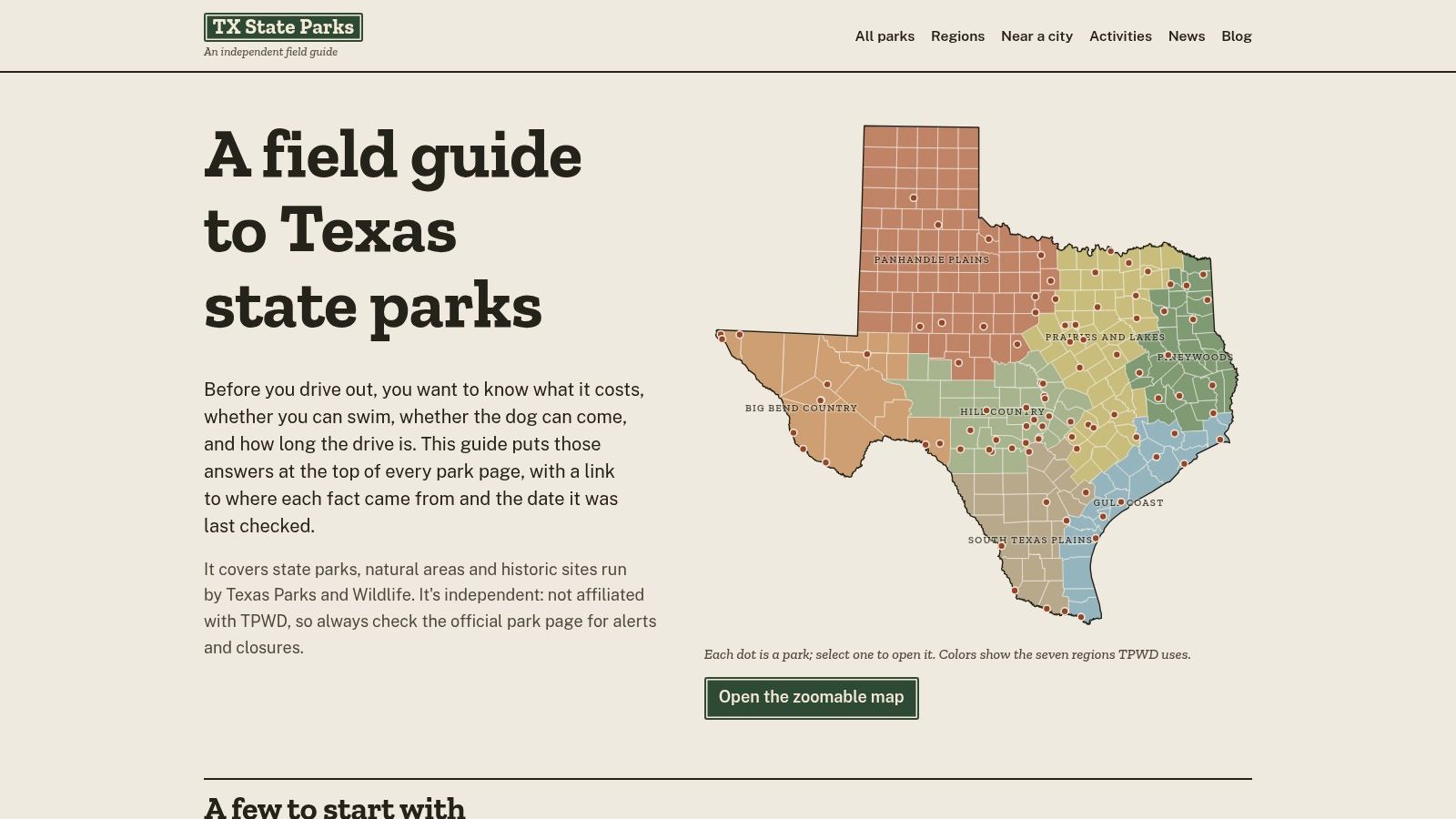
An independent guide like TX State Parks park pages can also help because it consolidates fees, pet rules, swim status, camping options, and source links on one page, with a clearly marked last-checked date. That doesn’t replace the official page, but it does make comparison easier when you’re choosing between parks.
A Quick Look at Dog-Friendly Texas State Parks by Region
If you’re trying to match a park to your dog, region helps. A shaded Hill Country creek walk, a wooded Pineywoods loop, and a windy Big Bend route all feel very different once you step out of the car.
TX State Parks regional guide makes that comparison easier, especially when you’re narrowing choices by terrain and season. The table below gives a fast orientation, not a complete park directory.
| Park | TPWD Region | Why It Works for Dogs | Watch Out For |
|---|---|---|---|
| Pedernales Falls State Park | Hill Country | Popular with walkers who want rocky scenery and river views | Stone surfaces can get hot, and footing can be uneven |
| Colorado Bend State Park | Hill Country | Good for active dogs that handle longer outings | Heat, steep sections, and limited shade in exposed areas |
| Tyler State Park | Pineywoods | Forested setting gives dogs a cooler-feeling walk | Mud, ticks, and trail traffic can build up after rain |
| Caddo Lake State Park | Pineywoods | Shadier surroundings and a slower pace suit many dogs | Water’s edge access and wildlife awareness still matter |
| Sea Rim State Park | Gulf Coast | Open coastal air and beach scenery appeal to many visitors | Salt, heat, and restricted swim areas need close attention |
| Caprock Canyons State Park | Panhandle Plains | Broad views and open trails can work for conditioned dogs | Exposure, heat, and distance from services can be demanding |
| Big Bend Ranch State Park | Big Bend Country | Best for experienced hikers who plan carefully | Extreme heat, rocky terrain, and wildlife exposure are serious concerns |
| Cedar Hill State Park | Prairies and Lakes | Convenient for metro-area day trips with dogs | Busy weekends and hot ground can make timing important |
A pattern emerges fast. Parks with more shade and easier footing are usually simpler for casual dog trips, while exposed, rocky, or remote parks need a more conservative plan. That’s why the region label is useful, but the watch-out column is what saves the day.
Common Misconceptions Dog Owners Bring to Texas State Parks
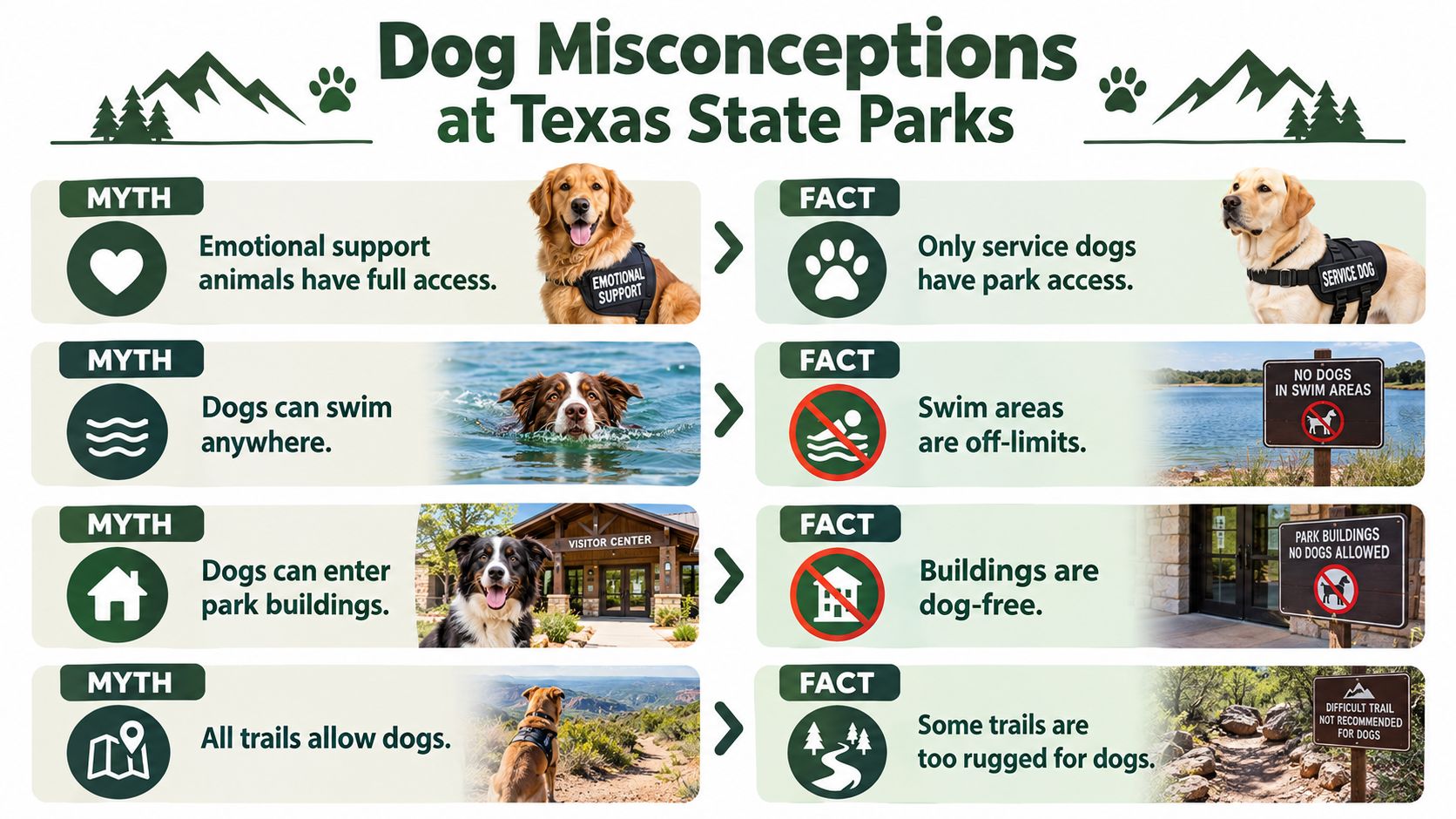
A lot of park trouble starts with a half-true assumption. The biggest one is that an emotional-support animal gets the same access as a service animal. It does not automatically, and the park rules draw that line clearly. The TPWD FAQ is the place to check if that distinction is fuzzy.
Four mistakes that cause most trouble
-
“It’s quiet, so I can unclasp the leash.”
Quiet does not change the rule. A dog still needs a leash no longer than 6 feet unless it is in a vehicle or suitable crate. -
“I can leave the dog in the car for a little while.”
Park rules do not allow a dog to be left unattended in a park or vehicle. Heat makes this a risky choice fast, even on a day that feels mild to people. -
“All trails are fair game once dogs are allowed.”
Park access and trail access are not the same thing. A park can welcome dogs and still close off specific trails, beaches, swim areas, or buildings. -
“If dogs are allowed in the park, they can go in the water too.”
Water access needs a closer look. Dogs are not allowed at designated swim beaches, and any park-specific exception should be confirmed on the park page before you rely on it.
The practical rule is simple. General permission tells you the dog can enter the park. Site-specific permission tells you where that dog can go, and those are not always the same thing. In crowded or sensitive areas, the difference matters most.
Putting It All Together for Your Next Trip
Use a short checklist before you leave home. First, confirm that dogs are allowed at the park and that you know the statewide rules. Second, read the park page for any trail, beach, building, or campground restrictions. Third, ask whether the park, season, and your dog’s condition fit together. Fourth, pack for control and comfort, not hope.
That means a leash, waste bags, water, paw protection if the ground is hot, and proof of current rabies vaccination. It also means choosing the hour carefully, especially in exposed parks or during hot weather, because a legal visit can still be a poor choice for the dog in front of you.
If you’ve got a few last-minute questions, the answers usually stay consistent. Rabies proof is advised by TPWD. Leaving a dog in a car is not something the park rules support. Swim beaches are not open to pets unless the park says otherwise, and that exception needs to be written down before you trust it.
A good dog-friendly Texas State Parks trip is part rules, part judgment, and part timing. The more you check before you go, the less you’ll have to guess at the gate.
If you want a practical place to start planning, TX State Parks organizes park pages with pet rules, swimming status, camping details, and source links in one place. Visit TX State Parks to compare parks, confirm the rules, and pick a trip that works for both you and your dog.
Fees, hours and rules change. Check the park's official TPWD page before you go.