9 Best Boating Lakes in Texas: Launches, Fees, and More
You’ve got the trailer hitched, the cooler packed, and a Saturday forecast that looks good. Then you reach the harder question. Which lake works for your boat, your passengers, and the ramp conditions this weekend, not just in a brochure photo?
That’s how you should choose among the best boating lakes in Texas. A family renting a pontoon needs reliable ramp access, nearby rentals, and predictable parking. An angler towing a bass boat needs a quieter launch, a usable ramp at current water levels, and coves that aren’t churned up by midday. A new operator needs calmer water and clear no-wake areas more than miles of open lake.
This guide compares nine Texas destinations by the logistics that decide your day. You’ll get direct picks by boat type, launch convenience, fees to confirm, crowd pressure, and amenities at or near the access point. Scenery matters, but it won’t save a trip if the ramp is closed, the lot is full by 9 a.m., or the lake doesn’t fit how you boat.
Pick the lake that matches your trip first, then verify the details. Entrance fees, launch fees, rental rules, and ramp status change, sometimes faster than park pages are updated. Check the official notice for your exact ramp before you leave, carry a life jacket for every passenger, and don’t assume a popular lake is automatically the right lake for your group.
Table of Contents
- 1. Lake Texoma (Eisenhower State Park, Texas Side)
- 2. Lake Travis
- 3. Lake Possum Kingdom (Possum Kingdom State Park)
- 4. Inks Lake (Inks Lake State Park)
- 5. Lake Somerville (Somerville Lake State Park)
- 6. Lake Whitney (Lake Whitney State Park)
- 7. Lake Livingston (Lake Livingston State Park)
- 8. Lake Ray Roberts (Isle du Bois and Greenbelt Units)
- 9. Lake Tawakoni (Lake Tawakoni State Park)
- Best Boating Lakes in Texas: 9-Lake Comparison
- Launch Confidently and Avoid Surprises on the Water
1. Lake Texoma (Eisenhower State Park, Texas Side)
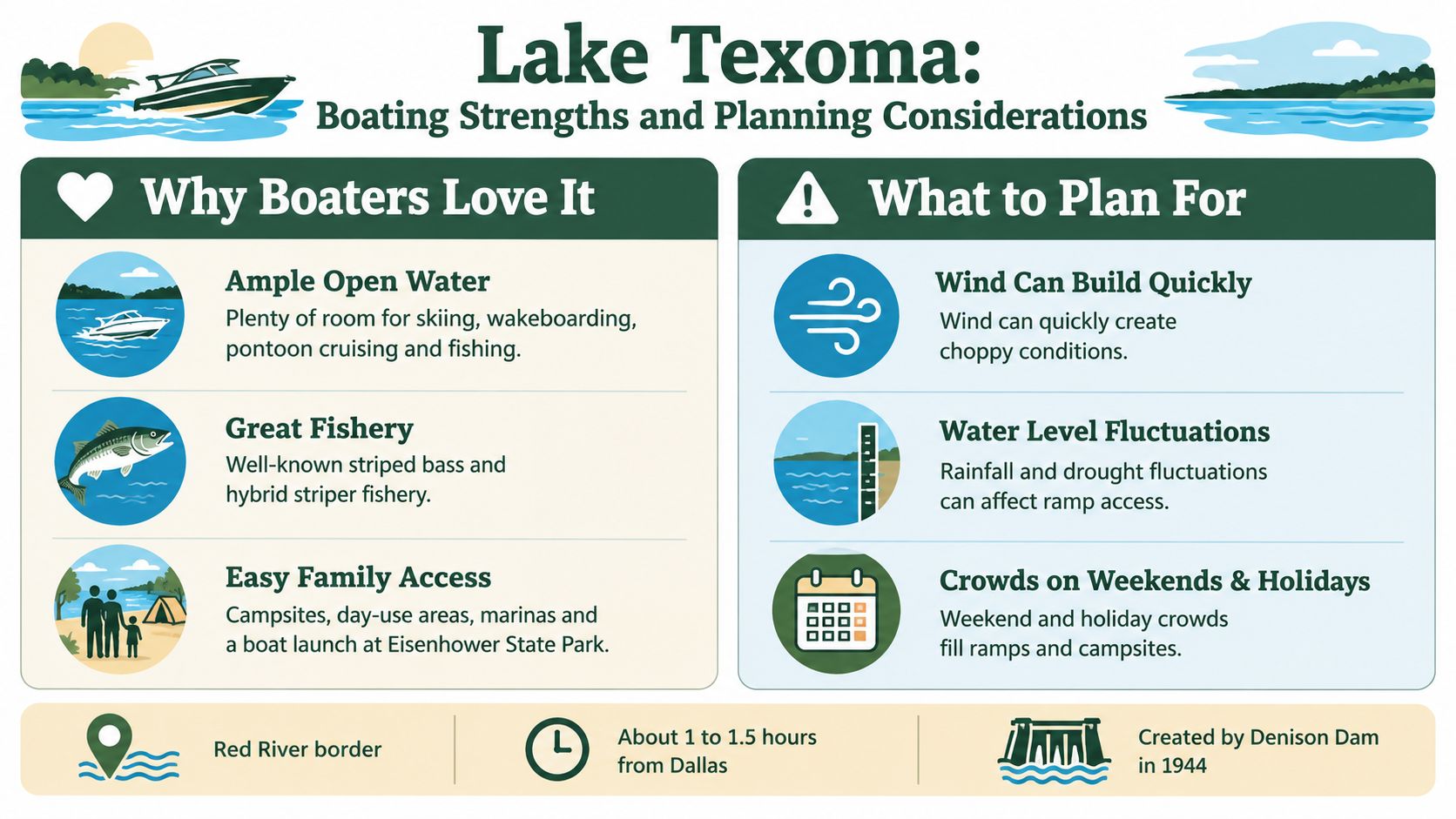
Choose Lake Texoma when you want scale and choices. This border reservoir near Denison suits family pontoons, ski boats, and houseboats because you’ve got broad open water, many shoreline sectors, and room to move away from the busiest launch areas. It’s a working lake first, built for flood control, water supply, and power, with recreation layered on top.
The size is the point. Lake Texoma has a surface area of 74,686 acres and a conservation capacity of 2,516,232 acre-feet, with designed total storage reaching 5,393,000 acre-feet, according to TPWD’s Lake Texoma lake page. For comparison inside Texas, Toledo Bend Reservoir covers 181,600 acres at conservation level, but Texoma leads on total storage capacity among lakes in or shared with Texas.
Why the Launch Network Matters Here
On the Texas side alone, Texoma has 39 public boat ramps across 21 access sites, a level of redundancy documented in TPWD’s Lake Texoma reservoir survey. That doesn’t guarantee your ramp is open today. It means you usually have a backup if one site is crowded, unusable at current elevation, or a long drive from your campsite.
Use Eisenhower State Park as your Texas base if you want a managed launch, marina access nearby, and camping in one plan. Anglers launch early from the park area for striped bass in spring and fall, while families rent pontoons from nearby marinas for summer day trips. If you’re browsing other state park options first, start with the Texas state parks boating activity index and then confirm Texoma conditions with the managing authority.
- Check both states: Texoma spans Texas and Oklahoma, so verify registration, safety gear, and fishing rules for the water you’ll cross.
- Reserve early: Summer and holiday campsites near Denison go fast, and the drive runs roughly 1 to 1.5 hours from Dallas depending on traffic.
- Fit life jackets before launch: Texas requires children under 13 to wear one on a vessel under 26 feet while underway, and every passenger needs one aboard.
2. Lake Travis
Pick Lake Travis for water sports, sailing, and social boating close to Austin, but only after you’ve checked the elevation. This is the most condition sensitive lake on this list. When the water’s up, it’s one of the easiest large lake days in Central Texas. When it’s down, your launch plan can fall apart.
Mansfield Dam was completed in 1942, creating a reservoir approximately 65 miles long and covering more than 19,000 acres that serves as the primary flood control reservoir in the Highland Lakes chain, as summarized in Houston Chronicle coverage of Texas boating lake histories. That same history explains Travis’s mixed access today. Much of the shoreline runs through private marinas, LCRA parks, and county parks, not a single state park system, so fees and rules shift by ramp.
TPWD’s survey puts numbers on the risk. Above 667 feet mean sea level, 11 concrete public ramps were available and access was considered excellent, while below 650 feet only two public ramps remained, a drop of roughly 82%, according to TPWD’s Lake Travis reservoir survey. That survey also classifies Travis as mesotrophic, with a mean chlorophyll-a Trophic State Index of 40.8.
Practical rule: Treat 667 feet as your go or no-go screen for Lake Travis. Below it, expect fewer ramps, longer drives between launches, and trailer congestion that can eat your morning.
Austin families do best here with an early launch, a rented pontoon, and a target cove on the western shore before traffic builds. Sailing clubs use the open water for regular spring and fall races, which tells you the lake rewards operators who can handle chop and shared water. Allow about 30 to 45 minutes from central Austin, confirm whether your ramp is public, county, or private, and read this guide to clean lakes in Texas if water clarity is shaping your short list.
3. Lake Possum Kingdom (Possum Kingdom State Park)
Go to Possum Kingdom when you want a scenic North Central Texas lake without the density of Travis or Texoma. The Brazos River reservoir in Palo Pinto County gives you rugged shorelines, limestone cliffs, and clearer coves for swimming, cruising, and tying off with friends. It’s a better fit for a full weekend than a quick after work launch.
Possum Kingdom State Park is your practical anchor. You get TPWD managed campsites, day use areas, and boat access in one place, which simplifies fees and parking compared with piecing together private access around the lake. Rent a cabin or campsite, launch from the park side, and you don’t have to trailer in and out each day.
Watch the video below before you commit to coves near the cliffs, because the shoreline rewards slow navigation and punishes careless approaches.
Groups tie off in coves for swimming in summer, and sightseers cruise the cliff lines rather than running long open water routes. That pattern suits runabouts, pontoons, and smaller fishing boats operated by people who’ll respect no-wake courtesy near swimmers. It doesn’t suit anyone who expects fuel, food, and marine services around every bend.
Plan for Limited Services
- Carry what you need: Bring fuel, food, and drinking water because services near the lake are limited and spread out.
- Watch the shoreline: Submerged rocks and changing levels make close to shore navigation risky, especially for first time operators.
- Check before you tow: Review current TPWD park alerts and fee details, and plan roughly 1.5 to 2 hours from Fort Worth.
If your group wants cliff scenery, a state park base, and less metro pressure, Possum Kingdom beats bigger lakes. If you need walkable restaurants and rental fleets at the ramp, choose Travis or Texoma instead.
4. Inks Lake (Inks Lake State Park)
Choose Inks Lake if smaller and calmer is the whole point. This compact Colorado River reservoir in Burnet County is the right call for paddlers, small boats, and relaxed family boating northwest of Austin. Don’t bring a big wake agenda here and expect Travis style open water.
Inks Lake State Park gives you granite outcroppings, clear coves, and direct park access that keeps planning simple. Paddlers launch kayaks on calm mornings to work the coves before wind and day use traffic pick up. Families who want a boat day mixed with swimming and short hikes get more value here than speed focused groups.
Devil’s Waterhole is the draw off the boat. Swimmers and divers reach it by a short trail, and it gets busy on summer weekends. Check current swimming and diving rules on the TPWD park page before you go, because what’s allowed there isn’t a guess you should make at the shoreline.
The photo below shows the boating style that fits Inks Lake best, close shoreline paddling among granite and trees rather than long high speed runs.
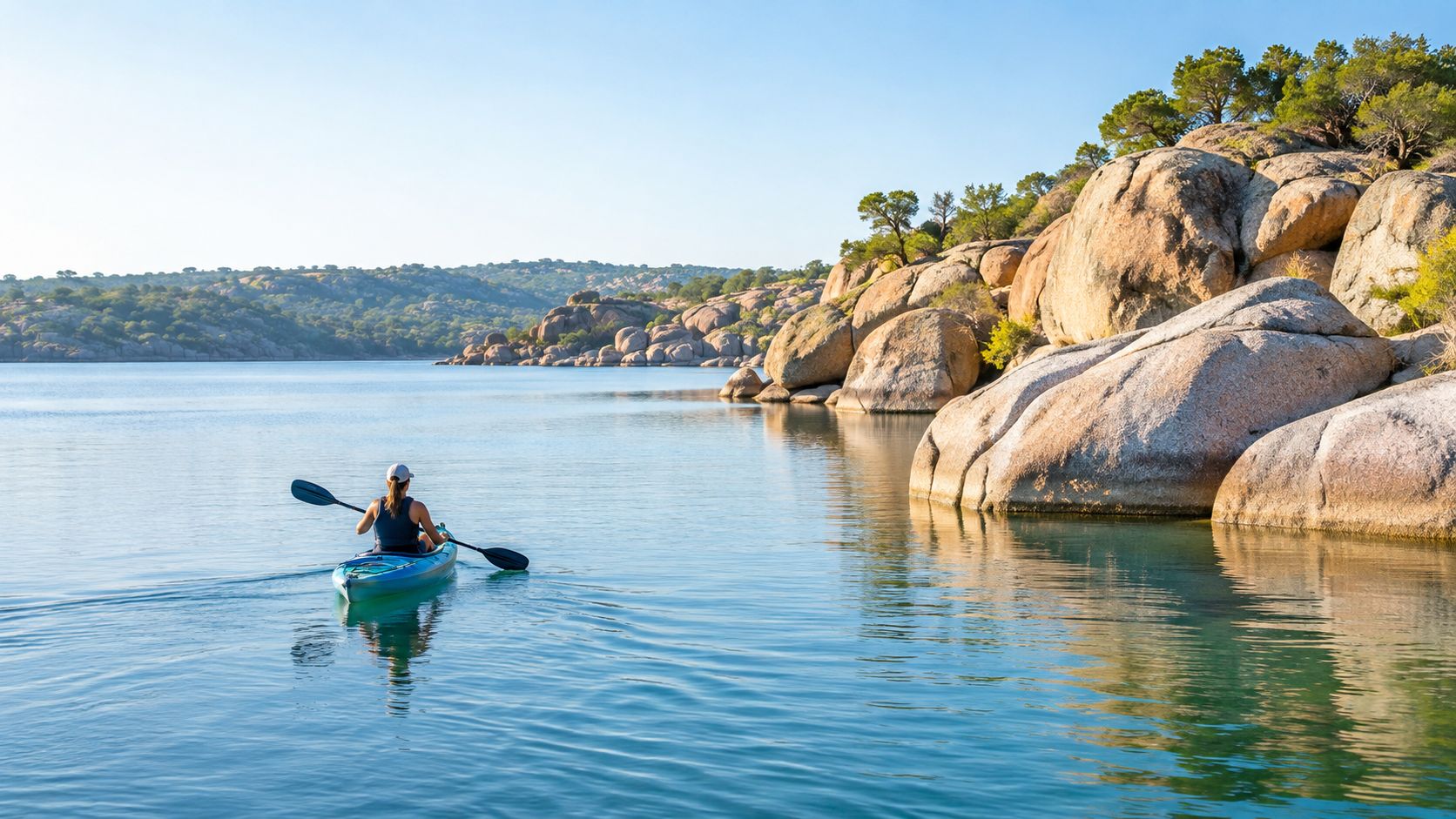
Arrive early on weekends because parking and launch areas fill quickly at popular Highland Lakes parks. Bring water shoes for the rocky shoreline, pack shade for passengers who’ll swim more than ride, and plan about 1 hour from Austin. Confirm the current entrance fee and any launch related cost before departure, since state park pricing and day use capacity rules can change.
For beginners, Inks Lake is one of the strongest picks among the best boating lakes in Texas. You get manageable distances, visible shorelines, and a park base if weather turns. For towing tubes all afternoon, pick a larger reservoir.
5. Lake Somerville (Somerville Lake State Park)
Lake Somerville works best for boaters between Austin and Houston who want forested shoreline and a state park ramp without driving to a metro reservoir. The lake sits on the Yegua and Brazos system in Burleson and Washington counties, and it handles fishing, paddling, and moderate motorboating well. It’s not the place for a party fleet. It’s a solid, natural feeling weekend lake.
Your first decision is which unit to use. Somerville Lake State Park includes Birch Creek and Nails Creek, and they aren’t interchangeable for your launch plan. Anglers use the Birch Creek ramp for early bass trips, while campers base at Nails Creek and combine paddling with hiking. Confirm which unit has the ramp, campsite type, and day use setup you need before you drive.
Best Fit by Trip Style
Pick Birch Creek when fishing is the priority and you want to be on the water at first light. Pick Nails Creek when your group splits time between the boat, camp, and trails, and nobody wants to spend the whole day underway. If you’re comparing fishing access across parks, the Texas state parks fishing activity index helps you narrow ramps before you check Somerville’s current alerts.
Crowds here are usually easier than at Travis, but warm weekends still fill campsites and lots. Bring insect repellent for wooded areas, especially at dawn and dusk launches. Plan about 1.5 hours from Houston or Austin, and verify current fees and camping availability on the TPWD park page rather than relying on an old screenshot or a friend’s last trip.
Launch early, fish the quieter shoreline first, and save paddling for protected water if afternoon wind builds across the main lake.
Somerville rewards planners who choose the right unit. Show up at the wrong entrance with a trailer and you’ll lose the calm morning you came for.
6. Lake Whitney (Lake Whitney State Park)
If you want quiet Central Texas water between Waco and Fort Worth, pick Lake Whitney. This Brazos River reservoir in Bosque and Hill counties is built for bass and crappie anglers, kayaking families, and campers who prefer a less developed shoreline. You won’t get a marina scene. You’ll get coves, calmer traffic, and a state park base that keeps the day simple.
Lake Whitney State Park provides the ramps, campsites, and shoreline access most visitors need. Bass anglers launch early from the park to fish coves before recreational traffic spreads out. Families camp at the park and use kayaks along the calmer shoreline, which suits mixed age groups better than a large open reservoir on a windy day.
Whitney’s trade off is self reliance. Services feel thinner once you leave the ramp, so your boat needs to leave the dock ready. Pack drinking water, sun protection, a first aid kit, and a marine radio or a phone with a charged battery. That’s not optional summer advice in Central Texas heat, it’s basic trip prep.
- Best for anglers and paddlers: Smaller fishing boats and kayaks use the coves well without fighting heavy wake traffic all day.
- Best for campers: Staying in the park removes daily trailering and gives you first access to morning water.
- Less ideal for renters: If you don’t own a boat and need a large rental fleet at the ramp, Travis or Texoma gives you more options.
Plan about 1 hour from Waco and 1.5 hours from Fort Worth. Check the TPWD park page for current fees, camping rules, and ramp status before you leave, and don’t assume low water hasn’t changed usable ramp length since your last visit.
Whitney is a deliberate choice, not a backup. Choose it when quiet water matters more than amenities.
7. Lake Livingston (Lake Livingston State Park)
Houston boaters who want East Texas forest instead of Hill Country limestone should look at Lake Livingston. This large Trinity River reservoir was created in the 1960s for water supply, flood control, and recreation, and it now serves bass and catfish anglers, paddlers, and family campers well. The scale gives motorboats room, while the coves give smaller craft places to get out of the main traffic.
Lake Livingston State Park is the cleanest access plan for most visitors. You get boat access, camping, and day use areas managed by TPWD, with one fee and alert source to check. Houston area anglers use the park ramp for weekend bass and catfish trips, and paddlers work the coves on calm spring and fall days when heat and insects are less punishing.
The image below captures the Livingston experience at its best, a small fishing boat on calm water with pine forest tight to the shoreline.
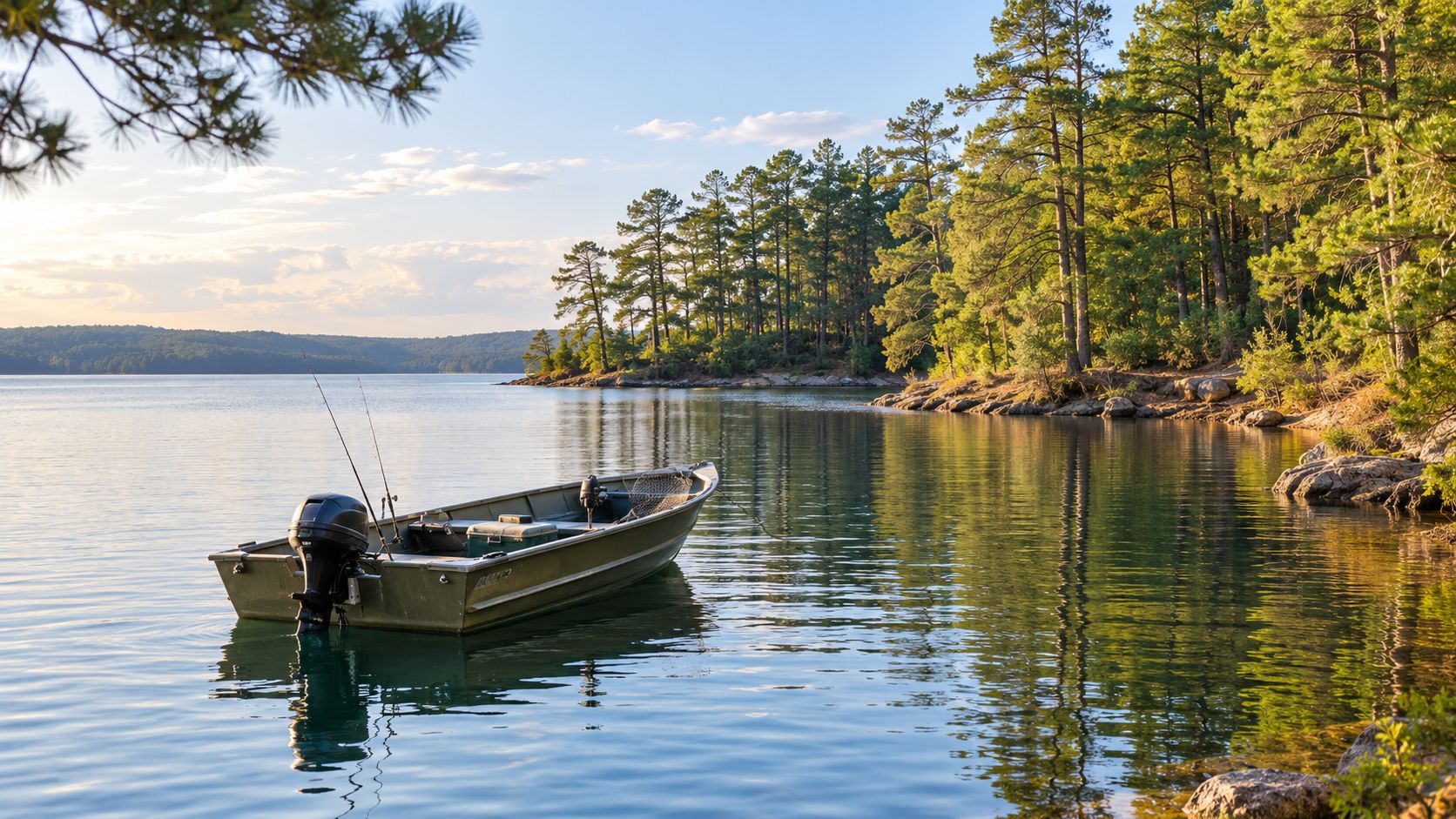
Bring a fishing license if you plan to fish and review current bag limits before launch, not at the cleaning station. Use insect repellent and consider long sleeves in warm months, especially for early and late launches near wooded shoreline. Check TPWD park alerts for ramp conditions and fishing regulations, because East Texas rainfall and lake operations can change access and shoreline hazards.
Plan about 1 hour of driving from Houston, which makes Livingston realistic for a day trip if you launch early. It’s less convenient if you need extensive marina dining or a large rental inventory at the park ramp. For owners with their own fishing boat or kayak, that trade is worth it. You’ll spend less time in launch lines than at closer in metro lakes and more time in coves that feel wooded.
8. Lake Ray Roberts (Isle du Bois and Greenbelt Units)
For Dallas Fort Worth residents, Lake Ray Roberts is the most practical state park boating choice north of Denton. The reservoir on the Elm Fork of the Trinity River is managed by the U.S. Army Corps of Engineers, while TPWD operates Lake Ray Roberts State Park units including Isle du Bois and Greenbelt. That split management is exactly why you need to pick your unit before you hitch the trailer.
Use Isle du Bois when your priority is a straightforward family launch for a small motorboat, fishing boat, or day on the water with camping nearby. Dallas area families launch there on summer weekends because the plan is simple and the drive is manageable. Use Greenbelt thinking when your group wants to combine paddling, hiking, and camping in spring or fall rather than run the main lake all day.
Avoid the Weekend Ramp Crunch
- Choose the unit first: Confirm which unit has the launch, parking, and campsite you booked.
- Arrive early: Weekend parking and ramp access tighten fast for a lake this close to the metroplex.
- Verify fees and alerts: Review TPWD park pages for current entrance costs, camping availability, and closures that affect your unit.
Plan roughly 45 minutes to 1 hour from Dallas or Fort Worth, traffic dependent. That convenience is the advantage and the drawback. You’ll save fuel and drive time compared with Texoma or Possum Kingdom, but you’ll share the ramp with everyone else who had the same idea.
Ray Roberts suits owners of small to midsize boats, kayak anglers, and campers who want a repeatable weekend lake. If you want houseboat scale water or a destination marina trip, drive farther north to Texoma. If you want to be home for dinner, stay here and launch early.
9. Lake Tawakoni (Lake Tawakoni State Park)
Pick Lake Tawakoni when you want East Texas fishing water east of Dallas without the intensity of the closest metroplex reservoirs. This Sabine River reservoir was created for regional water supply, and Lake Tawakoni State Park gives you TPWD managed boat access, camping, and wooded trails in one base. It’s a quieter, more deliberate boating day.
Anglers launch from the state park ramp for early crappie trips and bass fishing along the shoreline. Families camp in the park and use kayaks in calm coves, which works well for passengers who don’t want a full day of open water cruising. The lake suits fishing boats, small pontoons, and paddlecraft better than large water sports groups looking for long towing runs.
Tawakoni’s appeal is lower pressure, not more amenities. Bring insect repellent, plan for shade on summer days, and carry your own food, water, and fishing gear rather than counting on services at the ramp. Confirm current fishing regulations and license requirements before you launch, and check TPWD alerts for ramp status after heavy rain or low water.
A dependable ramp at a quieter lake beats a famous lake where you spend the morning in a parking line.
Plan about 1 hour of driving from Dallas. That puts Tawakoni in direct competition with Ray Roberts for DFW boaters, and the choice comes down to trip style. Choose Ray Roberts for the Isle du Bois and Greenbelt unit variety. Choose Tawakoni for wooded camping, crappie focused mornings, and a calmer East Texas shoreline.
Neither lake needs overselling. Both work because they’re close, manageable, and honest about what they offer. Tawakoni is the pick when fishing and quiet coves outrank marina access.
Best Boating Lakes in Texas: 9-Lake Comparison
| Lake | 🔄 Planning Complexity | ⚡ Resource Requirements | 📊 Expected Experience | Ideal Use Cases | ⭐ Key Advantages |
|---|---|---|---|---|---|
| Lake Texoma (Eisenhower State Park) | Moderate; check wind, lake levels, and busy-period access | Boat or rental; ramps, marinas, camping, and day-use facilities available | Large open-water recreation; conditions can turn choppy | Striped bass fishing, watersports, pontoon trips, family camping | Extensive boating space, strong striper fishery, and convenient Dallas access |
| Lake Travis | Moderate; access rules vary by operator, and popular launches get crowded | Boat or rental; multiple ramps, marinas, parks, and rentals | Deep, clear water, scenic coves, and a lively watersports scene | Austin day trips, swimming, sailing, tubing, and sunset cruises | Close to Austin with abundant marinas and recreation options |
| Lake Possum Kingdom (Possum Kingdom State Park) | Moderate; plan for limited nearby services and rocky shallows | Boat or rental; park ramp, campsites, and cabins; bring supplies | Clear water, rugged scenery, and generally less-crowded weekdays | Scenic cruising, watersports, swimming, and camping | Dramatic shoreline, clear water, and park lodging |
| Inks Lake (Inks Lake State Park) | Low to moderate; arrive early during warm weekends | Kayak, paddlecraft, or small boat; park ramp and campsites available | Relaxed, small-scale boating with clear water and granite scenery | Kayaking, paddling, swimming, and diving at Devil’s Waterhole | Quiet atmosphere and convenient Austin access |
| Lake Somerville (Somerville Lake State Park) | Moderate; identify the correct park unit and ramp in advance | Boat or paddlecraft; ramps, campsites, and day-use areas across multiple units | Natural, wooded setting suited to varied outdoor activities | Fishing, paddling, motorboating, camping, and hiking | Multiple access areas and a useful location between Austin and Houston |
| Lake Whitney (Lake Whitney State Park) | Low to moderate; check ramp status and prepare for heat and limited services | Small boat or kayak; state park ramp, campsites, and day-use areas | Generally peaceful boating with productive fishing coves | Bass and crappie fishing, kayaking, and family camping | Fishing reputation, quieter waters, and access from Waco or Fort Worth |
| Lake Livingston (Lake Livingston State Park) | Low to moderate; prepare for heat, humidity, and insects | Boat or paddlecraft; state park boat access, camping, and day-use areas | Calm coves and forested scenery; fishing and paddling opportunities | Bass or catfish fishing, paddling, and Houston-area weekends | Large lake, wooded shoreline, and convenient Houston access |
| Lake Ray Roberts (Isle du Bois and Greenbelt units) | Moderate; choose the right unit and plan around weekend crowds | Boat or paddlecraft; ramps, campsites, and trails at multiple units | Versatile recreation across coves and open water | Fishing, boating, camping, hiking, and DFW day trips | Multiple access points and a broad mix of activities |
| Lake Tawakoni (Lake Tawakoni State Park) | Low to moderate; check ramp status and changing water levels | Boat or kayak; park ramps, camping, trails, and day-use areas | Wooded, comparatively quiet setting with fishing and paddling options | Bass and crappie fishing, kayaking, camping, and Dallas day trips | Good fishing, park facilities, and convenient Dallas access |
Launch Confidently and Avoid Surprises on the Water
There’s no single winner among the best boating lakes in Texas, and pretending otherwise sends people to the wrong ramp. Texoma fits large boats and multi day trips where launch redundancy matters. Travis fits Austin water sports and sailing when elevation supports public ramps. Inks Lake and Lake Whitney fit beginners, paddlers, and families who need calmer water. Ray Roberts and Tawakoni fit DFW owners who want a repeatable drive. Livingston and Somerville fit anglers and campers who prefer forested shoreline over a marina scene.
Match the lake to your hull and your passengers before you think about scenery. A rented pontoon with children aboard needs a managed launch, nearby parking, clear no-wake water, and life jackets that fit. A bass boat needs a ramp that’s usable at today’s elevation and early access to coves. A kayak needs protected shoreline more than open water, and a wake boat needs depth, room, and distance from swimmers and anchored boats.
Water level is not a footnote in Texas. Canyon Lake fell to 46% full during drought with some public ramps closed for more than a year, then rose to 67% full and reopened ramps 1, 14, 18, and 19 in July 2025, a swing documented in Drought Reporter impact records for Canyon Lake ramp reopenings. That same reporting notes low level restrictions elsewhere, including closed ramps at Abilene State Park and a closed courtesy dock at Lake Casa Blanca. Your takeaway is specific. Name your ramp, check its status and the lake level on the day you travel, and keep a backup launch in your phone.
Safety data should shape your lake and launch choice, not just your gear list. TPWD reported 169 boating incidents in Texas during 2024, including 24 water fatalities, with 22 involving people not wearing life jackets, and 78 incidents causing injuries to 100 people, according to TPWD’s boating safety news release. More recent 2025 reporting in that verified record notes 227 vessel incidents and 50 fatal incidents, with 84% of fatal incidents involving no life jacket and 89% of alcohol related incidents involving injury or death. Don’t repeat those numbers as trivia. Use them. Put every passenger in a properly fitted life jacket, keep alcohol off the operator’s plan, avoid crowded holiday water if you’re inexperienced, and choose calmer coves when children or new boaters are aboard.
Before you leave, confirm five things for your exact access point. Check the park entrance fee, any launch fee, rental availability, no-wake restrictions, and current ramp status. Then check the managing authority, because a TPWD state park ramp, an LCRA park, a county ramp, and a U.S. Army Corps of Engineers site don’t share one rulebook or one closure notice. TX State Parks can help you narrow TPWD options with searchable boating, camping, and paddling pages, fee details, source links, last checked dates, and estimated drive times. That short list work saves time, but it doesn’t replace the official TPWD, LCRA, or Corps notice on launch morning.
Do that homework and Texas boating gets simpler. You’ll launch at a ramp that’s open, in water that fits your boat, with passengers who are dressed for the conditions. That’s a better definition of a best lake than size alone.
Use TX State Parks to compare Texas state park boating, fishing, camping, and paddling options with fees, source links, last checked dates, and drive time estimates in one place. Narrow your lake by activity and region, then open the official park notice to confirm today’s ramp status before you tow.
Fees, hours and rules change. Check the park's official TPWD page before you go.